01
ISF is not blood.
Each analyte gets its own evidence, lag, calibration, and claim. No universal conversion turns a patch into a lab panel.
CBM G1 is a sourced, open-hardware research platform for interstitial-fluid sensing: six target chemistries, two quality-control channels, and a system designed to stop reporting when the measurement stops earning trust.
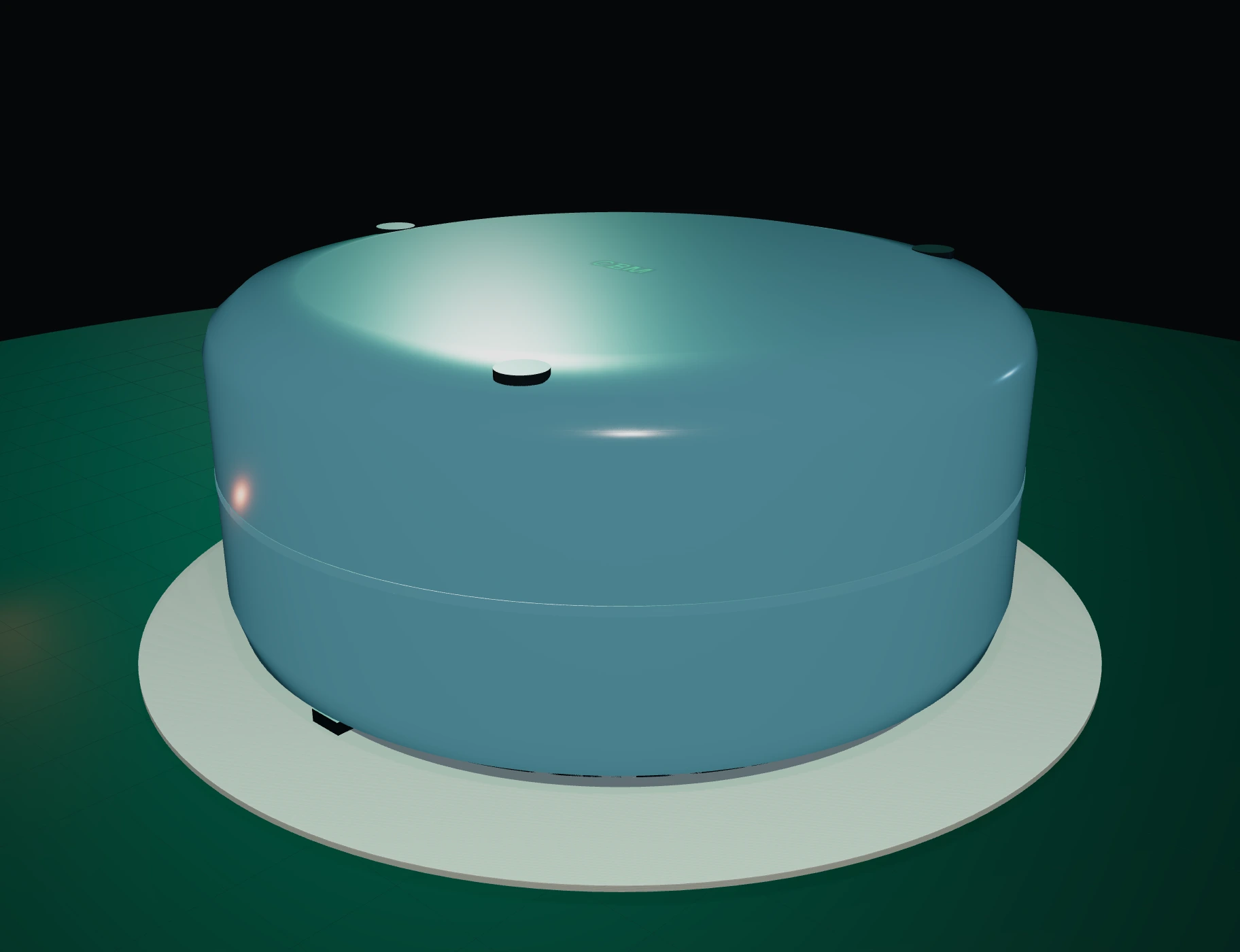
CBM starts with the errors that can fabricate a plausible number, then designs the hardware, controls, and public claims around exposing them.
Each analyte gets its own evidence, lag, calibration, and claim. No universal conversion turns a patch into a lab panel.
Five picoamps across a gigaohm membrane becomes five millivolts—roughly the entire potassium move from 5 to 6 mmol/L.
A six-needle tile approaches the active area of the bench electrode and does not let one missed insertion erase a channel.
Raw data are retained, but a failed reference, blank, duplicate, contact, or calibration gate yields no interpreted value.
No patient needs to rely on this unvalidated device today. The public-interest case is conditional: a trustworthy trend must trigger earlier confirmation, that confirmation must change care, and the changed care must improve an outcome that matters.
Its clearest near-term contribution to human flourishing is as open translational infrastructure: one reusable instrument that lets research and clinical teams test several chemistries without designing a new reader for each one. Its largest potential patient benefit comes later, in high-risk populations where chemistry changes faster than scheduled testing and a trend has a predefined confirmatory action.
Who needs it: university, hospital, and public-interest biosensor groups that otherwise duplicate reader electronics before testing chemistry. Open hardware, raw traces, interchangeable tiles, and shared validation methods can make this a scientific public good.
Who may benefit: diabetes/DKA, CKD or heart-failure medication titration, dialysis, acute-care lactate surveillance, and narrow-therapeutic-window drug dosing. Glucose+ketone already has a commercial incumbent; added value must come from validated additional channels or a better workflow—not novelty alone.
Best distributed form: reusable readers in clinics, step-down units, research hospitals, and regional programs with local cartridges, trained operators, quality control, and referral labs. WHO guidance is explicit: decentralized tests create value only inside financed, quality-assured diagnostic networks.
Who does not need it: healthy people without a defined action for each result. Broad deployment would add false alarms, false reassurance, surveillance, medicalization, cost, and disposable waste. Existing CGM use already generates large packaging and electronic-waste streams.
Earlier detection for fragile patients; fewer avoidable venipunctures and trips; more autonomy between visits; preservation of beneficial therapy; and wider research capacity through open, reusable instrumentation.
Bad signals can provoke overtreatment or false reassurance. Continuous biochemical surveillance can erode privacy and turn normal variation into illness. Disposable cartridges consume materials and clinical attention that may produce more benefit elsewhere.
The reusable puck owns measurement modes and data integrity. The disposable cartridge owns every tissue-contact material, sensing chemistry, reference, counter, lot, and calibration.
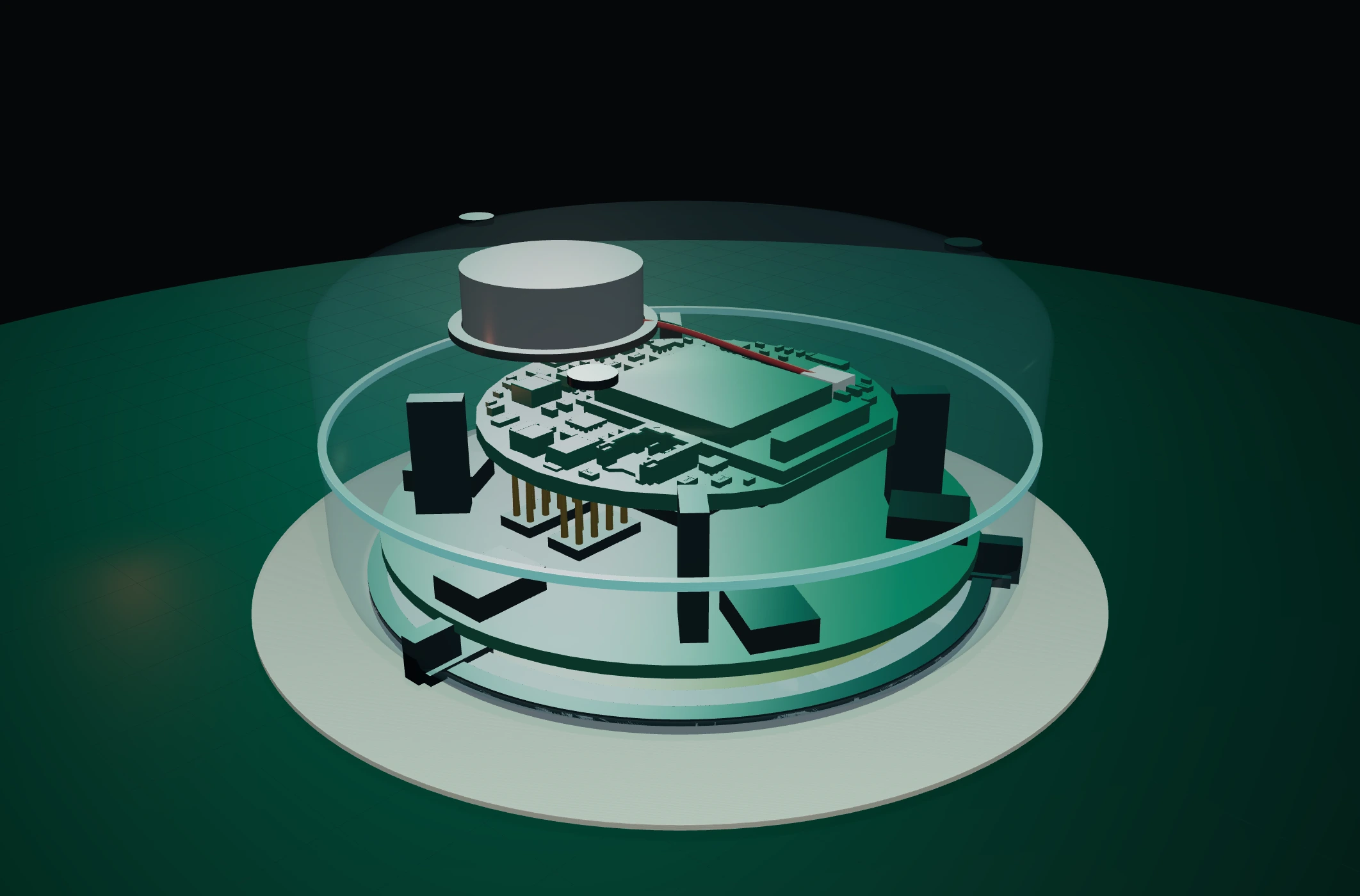
Actual populated Biocoin, 38 mm daughterboard, cradle, harness, and retainers.
Eight isolated tiles on a 32 mm open sensing field.
One retained Mill-Max 817 connector at 2.24 mm working height.
Nominal STEP-backed clearance checks; unresolved tests stay named.
The panel spans mediated enzyme and ion-selective sensing without pretending every channel has the same maturity.
Prussian Blue + GOx. Commercial anchor and system sanity reference.
HBD/NAD+/poly-TBO stack. The strongest reason to measure beyond glucose.
LOx-mediated research lane with human microneedle precedent and analyte-specific lag.
Separate deposition lane exposes missed insertion and lane-specific coating failure.
PEDOT:PSS + ionophore X. Electrolyte context and common-mode reference witness.
Valinomycin membrane. Highest-value and least-forgiving quantitative research lane.
Polyaniline starting route. Context for chemistry, junction behavior, and drift.
A nonspecific electrochemical sentinel—not a magical universal correction.
G0 and G1 are separate so a coating mistake cannot hide inside a custom wearable, and an enclosure cannot be mistaken for a sensor.
PalmSens drives amperometry and deposition. A guarded electrometer path owns high-impedance truth. Every chemistry earns its own ladder, interference matrix, drift record, and induced-fault result.
The published Biocoin PCB survives intact and mates through its own docking pads. Custom work is limited to the guarded interface board, retained cartridge, sensor tiles, seals, and enclosure.
The build book carries the dimensions, materials, process windows, source method, and acceptance test for each custom item.
38 mm full disc with six LMP7721 islands, ADS124S08, four upstream-exact dock headers, and the retained 12-contact connector.
Open specification →Published PS/PDMS mold route: 1.0 mm needles, 10 nm Cr, 150 nm Au, plus dimensional, insertion, and coating QC.
Open specification →Nickel-free gold-coated 30–36G vendor route with isolation, pinhole, corrosion, coating, and traceability requirements.
Open specification →25 µm polyimide core, eight tile landings, two references, CE, hard-gold dry boss, and no exposed wet-side nickel or copper.
Open specification →Separately fabricated Ag/AgCl reservoirs and central Pt counter, released by drift and compliance—not color or geometry.
Open specification →ARcare 7759 passivation, converted 4077 skirt, dry-field ingress barrier, keyed stop, and assembly-level biological evaluation.
Open specification →Commercial, human, animal, and engineering evidence answer different questions. G1 keeps those labels attached.
Glucose + ketone every minute; up to 15 days. Not cleared in the United States.
Abbott · May 2026 ↗26 mm multimodal AD5940+nRF52840 platform with published hardware, firmware, software, and STEP.
npj Biosensing · 2026 ↗Six simultaneous analytes in rats; modular 2×3 tiles. Continuous stability: 120 minutes in artificial ISF.
Nano-Micro Letters · 2026 ↗Eight target + eight control channels; n=3 challenge and n=3 overnight. Promising, not cleared.
Diabetes · 2026 ↗Seven people over 14 days; dynamics captured, progressive decline consistent with sensor drift.
JMIR Diabetes · 2026 ↗A functional microneedle cartridge does not go from artificial ISF to a self-test. Human research requires IRB review, the appropriate IDE or nonsignificant-risk determination, informed consent, final-assembly biological evaluation, sterilization and packaging evidence, electrical safety, comparators, and stop rules.
The interactive model exposes each sourced and custom part. The build book carries the BOM, custom-part process, material sources, validation gates, and downloadable CAD.