Severity with structure.
Fourteen curated GI symptoms — bloating to brain fog — on a 0–10 clinical severity scale, with duration, body area, and triggers like "After eating" or "Poor sleep."
StatsKey turns gut health into structured, private, clinician-legible data: a fifteen-second Gut Check with Bristol-scale precision, a live 0–10 GI Burden Score, optional device authentication for the record, and a straight line from every episode back to what you ate.
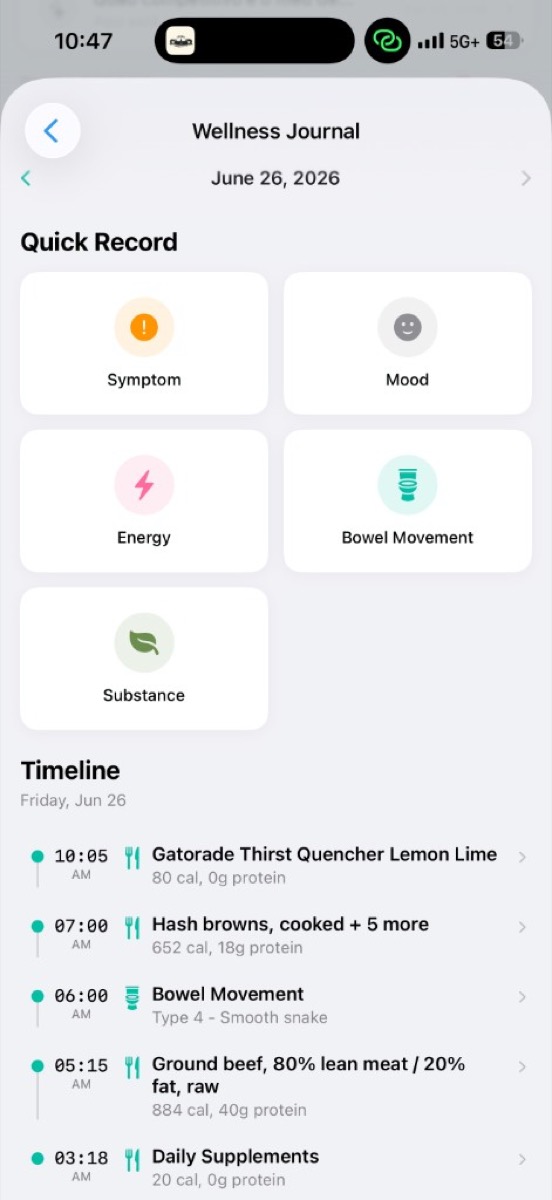
Type 4 · Smooth snake · GI burden 1/10 · effortless
Good · stress 3/10 · calm morning
31g protein · 9g fiber · glucose mapped
Afternoon dip · after caffeine
Bloating · 4/10 · optional follow-up at 8:20 PM
Around 40% of people live with a gut–brain disorder, and most hide it — even from their own doctor. StatsKey makes the hardest signal in health effortless to record, impossible to judge, and ready to answer for itself.
The recorder is three tabs deep and zero judgment wide. Most days it's two taps; on the days that matter, it captures what a gastroenterologist would actually ask about.
The Bristol scale, color-coded and named — and when one movement changes form mid-episode, add phases: each gets its own type and portion, from Trace to All.
Quick-select capsules (1–20 min), an exact minutes:seconds entry, or a live stopwatch you start when you sit down.
Size, color, urgency, control, passage, cleanup, red flags, a private photo, feel tags, and notes — every one optional, every one structured.
Bristol Stool Form Scale (Lewis & Heaton, 1997) — the same instrument used in IBS clinical trials.
Not a vibe, not a smiley face — a deterministic score built from form, urgency, passage, cleanup, and control, with red flags that refuse to be averaged away. The demo below runs the same math the app runs.
The app's exact model: worst phase (form × portion), plus urgency, passage, cleanup, and control — any red flag floors the score at 8. It summarizes burden; it never diagnoses.
These aren't mockup words — this is the actual capture surface in the app, string for string. All of it optional, none of it awkward.
Red-flag entries never diagnose anything — they make a clinician summary clearer, and they always surface in the score.
The Bowel Record Lock masks every bowel row in the app — timeline, history, search — behind a 4–8 digit passcode with Face ID or Touch ID. Unlock once; it relocks the moment the app leaves the foreground.
Private photos go further: owner-only cloud storage, never shown on the timeline, and blurred until you deliberately tap Reveal. Wellness records never appear to friends, and substance records are excluded from Intelligence, reports, and sharing by default.
Honest fine print, straight from the app: it is an in-app viewing lock, not end-to-end encryption — and a forgotten passcode requires re-confirming your sign-in to reset.
Type 4 · GI burden 1/10 · effortless · easy cleanup
Mixed types 4/6 · GI burden 6/10 · urgent · after coffee
Bloating · 4/10 · lower abdomen — symptom rows stay visible
The Gut-Brain Check-In takes fifteen seconds: mood, a 0–10 stress read, and optional gut symptoms. Record stress of 6 or higher alongside a symptom and StatsKey quietly tags stress as a trigger.
Once ten days carry both a stress reading and a gut record, the Patterns card computes a real correlation across your days — and tells you the honest version: a link, an inverse link, or "no clear pattern yet."
Pearson correlation on paired days only · requires ≥10 paired days and |r| ≥ 0.20 before claiming anything · high-stress vs calm-day contrast needs ≥4 days per bucket. An association, not proof — and not medical advice.
Keep pairing stress check-ins with gut records — the engine stays quiet until it has real evidence.
Bowel movements are the headline, but the journal reads your whole day: symptoms, mood, energy, and substances merge with meals into a single connected timeline — tap any entry to edit, and locked rows stay masked.
A date navigator walks you back through any day, and a 14-day GI Observation Block turns it into a focused experiment when you want one.
Fourteen curated GI symptoms — bloating to brain fog — on a 0–10 clinical severity scale, with duration, body area, and triggers like "After eating" or "Poor sleep."
A five-point mood plus a 0–10 stress read underneath — because stress is the central mediator of the gut–brain axis, not a footnote to it.
Five levels with crash time and context tags — post-meal crash, after caffeine, poor sleep, well rested — so the afternoon dip stops being a mystery.
The most complete gut recorder in consumer health — everything on this page, in a flow that usually takes two taps.
Nicotine, cannabis, alcohol, caffeine, and more across 14 intake methods, with one-tap templates and photo-scan intelligence — private by default, everywhere.
Wellness entries, meals, and substances on one connected-dot timeline with monospaced time stamps — the same view Intelligence reads when you ask about your day.
Intelligence carries tools built specifically for the gut: pull every meal from the hours before an episode, search any food across your history and check what followed within 24 hours, or read the full wellness timeline day by day — Bristol averages and burden scores ride along in context.
Intelligence supports planning and optimization across all activities. Suggestions may be incomplete or inaccurate; review and adapt them to your needs before applying them. It is not medical advice.
get_full_wellness_timeline28 days · 41 recordsget_meals_before_event · 6h window9 meals matchedAn optional daily reminder — suggested for 9:00 AM — keeps the gut picture complete. Off by default, quiet-hours aware, and never smug about it.
After a symptom or a loose episode, an optional follow-up asks "How's your gut now?" — answer "Still bothering me" or "Resolved" right from the notification.
An optional post-meal gut check lands 90 minutes after you eat — at most once a day — exactly when a food reaction is worth writing down.
One tap builds a GI Health Records section into your PDF report: totals, days recorded, daily average, ideal-Type-4 share, your full Bristol distribution with meanings, and per-day tables of time, form, color, size, urgency, and notes.
CSV ships a dedicated GI_RECORDS block; JSON carries every field — mixed episodes encoded like T4:most|T6:some — for anyone who wants the raw record.
Ten recorded meals plus four gut checks and your food–gut context is ready — the app counts it down for you and marks the milestone.
The Wellness Journal is a self-tracking tool. GI burden summarizes what you recorded, red flags make a clinician summary clearer, and gut–brain patterns are associations — not proof, not diagnoses, and never a substitute for care.
The Wellness Journal is part of StatsKey — free to start, with the same fifteen-second capture philosophy as everything else: meals, glucose, training, and now the signal nobody talks about.